
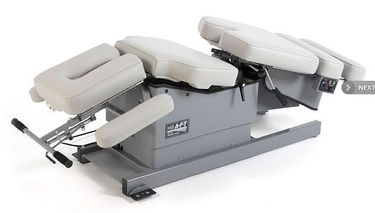
FLEXION DISTRACTION
Flexion Distraction is used in our office mainly for treating herniated discs of the lumbar spine. There are also many cases where a patient may not tolerate manual manipulation and this is a great alternative.
You may be familiar with axial decompression or other 'decompression' techniques. Many of these are unassisted machine-based treatments. Cox Flexion Distraction differs because it is a 'hands-on' decompression therapy that is controlled by the doctor. This is the reason we choose to utilize this in our office because of the ability to control pressure, vector, and timing interval. This makes it much more effective at reducing or eliminating a patient's symptoms in a shorter period of time.
Flexion-Distraction, (F/D) is a gentle, treatment procedure utilized for low back pain. Flexion-Distraction is a safe alternative to back surgery for those 95% of patients whose conditions do not demand surgical intervention. The doctor is in control of the treatment movements at all times.
Flexion-Distraction is utilized for many conditions such as:
How does Flexion-Distraction Work?
For Disc related conditions:
Patients with other conditions causing back pain (facet syndrome, spondylolisthesis, sprain/strain, scoliosis, transitional vertebra, sacroiliac restrictions and misalignment, certain types of spinal stenosis), Flexion/Distraction provides all of the above benefits plus the ability to place the spinal joints into normal, painless movements so as to restore spinal motion without pain:
Flexion Distraction is used in our office mainly for treating herniated discs of the lumbar spine. There are also many cases where a patient may not tolerate manual manipulation and this is a great alternative.
You may be familiar with axial decompression or other 'decompression' techniques. Many of these are unassisted machine-based treatments. Cox Flexion Distraction differs because it is a 'hands-on' decompression therapy that is controlled by the doctor. This is the reason we choose to utilize this in our office because of the ability to control pressure, vector, and timing interval. This makes it much more effective at reducing or eliminating a patient's symptoms in a shorter period of time.
Flexion-Distraction, (F/D) is a gentle, treatment procedure utilized for low back pain. Flexion-Distraction is a safe alternative to back surgery for those 95% of patients whose conditions do not demand surgical intervention. The doctor is in control of the treatment movements at all times.
Flexion-Distraction is utilized for many conditions such as:
- Disc Herniation/Ruptured Disc/Bulging Disc/Herniated Disc
- Sciatica / Leg pain
- Spinal and Foraminal Stenosis
- Failed course of Steroid Injections
- Chemical Radiculitis
- Spondylolisthesis
- Transitional segment
- Failed Back Surgery Syndromes
How does Flexion-Distraction Work?
For Disc related conditions:
- Increases the intervertebral disc height to remove annular tension on the annular fibers and nerve by making more room and improving circulation.
- Allows the nucleus pulposus, the center of the disc, to assume its central position within the annular fibers and relieves irritation of the spinal nerve.
- Restores vertebral joints to their physiological relationships of motion.
- Improves posture and locomotion while relieving pain, improving body functions, and creating a state of well-being.
Patients with other conditions causing back pain (facet syndrome, spondylolisthesis, sprain/strain, scoliosis, transitional vertebra, sacroiliac restrictions and misalignment, certain types of spinal stenosis), Flexion/Distraction provides all of the above benefits plus the ability to place the spinal joints into normal, painless movements so as to restore spinal motion without pain:
- The posterior disc space increases in height.
- F/D decreases disc protrusion and reduces stenosis.
- Flexion stretches the ligamentum flavum to reduce stenosis.
- Flexion opens the vertebral canal by 2 mm (16%) or 3.5 to 6mm more than extension.
- Flexion increases metabolite transport into the disc.
- Flexion opens the apophyseal joints and reduces posterior disc stress
- The nucleus pulposus does not move on flexion. Intradiscal pressure drops under distraction to below 100mm Hg. On extension the nucleus or annulus is seen to protrude posterior into the vertebral canal.
- Intervertebral foraminal openings enlarge giving patency to the nerve.